
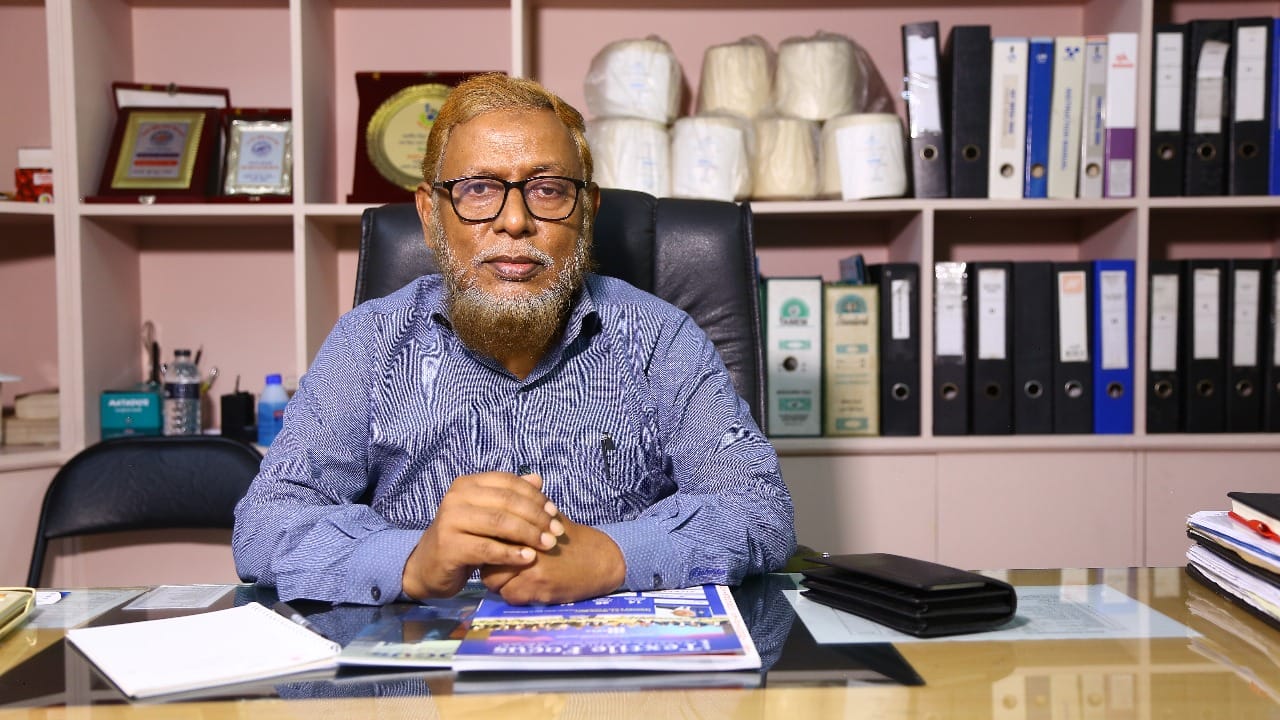
Amanat Shah Spinning producing premium quality yarn to boost RMG Export
By
Share Hazrat Amanat Shah Spinning Mills Ltd. (HASSML), a flagship concern of the Amanat Shah Group, began operations in 2004 and has since established itself as a leader in Bangladesh’s spinning sector. Situated on nearly 600,000 square feet of production space and operating 93,000 spindles, the mill produces around 32 tons of yarn daily over 1,200 tons monthly. Using premium cotton imported from the USA, Egypt, India, and Uzbekistan, along with state-of-the-art machinery sourced from Germany, Switzerland, Italy, and China, HASSML ensures consistent world-class quality. Its diverse product portfolio includes 100% cotton yarns (Card, Comb, and Compact) as well as blends such as Viscose, Tensile, Visita, Modal, Tencel, and Linen. The mill plays a crucial role in the Group’s integrated manufacturing chain, supplying high-quality yarn for weaving, knitting, dyeing, and finishing units, thereby enhancing efficiency and competitiveness. Built on the Amanat Shah Group’s 130-year legacy of trust and excellence, HASSML combines technological innovation with sustainability, ethical labor practices, and a commitment to producing globally competitive textiles.
In an engaging discussion with the Textile Focus team, Engr. Aslam Parvez, Executive Director of Hazrat Amanat Shah Spinning Mills Ltd. (HASSML), emphasized the premium quality yarn to boost RMG Export. He highlighted how HASSML is consistently investing in advanced technologies, sustainable practices, and boost yarn production to stay ahead in the competitive global apparel market. Read the full conversations-
Engr. Aslam Parvez said, “The entire spinning sector of Bangladesh is currently going through a challenging time. Let me start by saying that the spinning sector of Bangladesh developed for several reasons — from the very beginning, we had access to the European Union and the United States. In addition, our labor costs were low, and we used to get energy at very cheap rates. It was on the basis of these three factors that Bangladesh’s spinning sector was built.
At present, we are facing challenges in all three areas. Specifically, we are experiencing power interruptions and a gas crisis, and we are unable to run our machines at full efficiency while costs are increasing. In the socio-economic context, labor wages have also risen significantly. Moreover, if issues such as tariff challenges and other problems are not resolved quickly, the role this sector plays in Bangladesh’s economy may face obstacles. These matters need to be addressed jointly by the government and the various trade bodies. Based on our chairman’s long 60 years of experience, we have developed significantly. For value addition, we have invested in blended yarn production and are capable of making yarn from any fiber. We are also the first to produce from 20 count up to 140 counts in ring spinning, and from 6 count up to 30 counts in open-end spinning.”
He further added, “In the current context, we are in a very challenging position because the cost of production cannot be covered high power costs are not feasible for our country. Even with these high costs, we are not getting uninterrupted power supply, whether it be gas or electricity. We are moving towards automation, which provides an opportunity to reduce manpower. We are also heading towards product diversification products that were previously made only with cotton can now be made using blended products. We are trying to take advantage of the global demand for man-made fiber.
Our future plans include solving these problems and making the industry sustainable, overcoming the current situation, and implementing operations wherever productivity can be increased. We are working on rooftop solar projects and aim to do even better in the future meaning our focus will be on energy efficiency and automation so that our costs are reduced and we can remain in a sustainable position.”
Next article
#
Simillar News